Most referral programs don’t fail because the offer is weak.
They fail because nobody can answer one boring question: “Where did this lead come from?”
If you’re waiting for a CRM before you track referrals properly, you’re waiting too long.
A simple referral tracking system built with a spreadsheet, a form, and a few rules can do the job for many small businesses.
Let’s break it down so every referral has a source, a status, and a next step.
Start with one source of truth
The first mistake is trying to build the whole machine at once.
Don’t. Start with one spreadsheet, and make that sheet the only place referral data lives.
Google Sheets is fine.
Airtable is fine too.
Pick the tool your team will open every day, not the tool that looks smartest in a demo.
Your sheet needs one row per referred person.
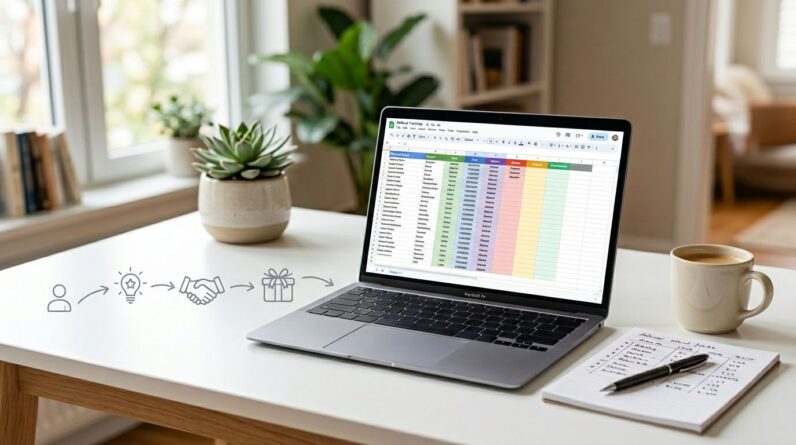
Keep it simple with columns for date received, referrer’s name, prospect name, contact details, service needed, owner, status, sale value, and reward owed.
If you want a model to copy, these referral tracking spreadsheet instructions show a clean layout.

A few fields matter more than the rest:
- The referrer and the source should be separate.
- The owner tells you who follows up.
- The status tells you what happens next.
- The reward column stops awkward “Did we ever send that?” moments.
This matters even more if you sell digital marketing, social media marketing, local SEO, lead generation help, sales skills coaching, or web design.
Prospects rarely arrive in a straight line.
Someone might hear about you from a mate, check your website, see your socials, then fill in a form three days later.
If you lump that into “website lead”, you’ve lost the story.
Keep source and revenue close together.
That’s how you start tracking marketing ROI effectively instead of guessing which channels pull their weight.
Capture each referral the same way, every time
A spreadsheet is the record.
It is not the intake method.
You still need a clean handoff.
The easiest option is a short form.
Google Forms, Typeform, Jotform, or even a dedicated email inbox can work.
What matters is consistency.
Every staff member, partner, past client, or supplier should send referrals through the same path.
Ask for five things and move on: who is referring, who is being referred, how to contact them, what they need, and whether they’ve agreed to be contacted.
That’s enough to act.

If your referrals come from a mix of phone calls, DMs, live chats, and in-person chats, give repeat referrers a basic code.
It doesn’t need to be fancy.
Something like SAM01 or PARTNER03 is plenty.
Codes help when the lead mentions you later, not at the moment of the intro.
That’s common in local SEO and social media marketing, where someone sees your name more than once before they enquire.

If a new referral can’t be logged in 30 seconds, people will stop doing it.
Set a rule for ownership too.
One person checks the form inbox or sheet at set times each day.
No shared shrug.
No “I thought someone else had it”.
Manual systems break at the handoff, not in the spreadsheet.
Add follow-up rules before you add software
Referrals are warm, but they still need process.
A warm lead ignored for two days goes cold like any other.
Set three status stages first: new, contacted, closed.
You can add more later if you want, but most small businesses don’t need a dozen labels.
They need clarity.
Then define the timing.
New referrals get a response within one business day.
Closed won referrals trigger a reward check. Lost referrals get a reason logged.
That gives you clean reporting without a CRM.
This is where people overcomplicate things.
A referral system is still a lead generation system. It needs speed, basic reporting, and follow-up.
It does not need a huge stack.
If you want light automation, there are a few low-cost ways to do it.
This Airtable and Gmail setup is a good example of how to log submissions, send alerts, and track rewards without buying a CRM.
If referrals come in from several forms or apps, these Zapier automation ideas can push them into one sheet.
Once the referral lands, the next steps can follow the same logic you’d use to build a lead funnel in under a week.
Quick contact, clear notes, and one defined next action.
Also, let’s be honest, software won’t fix weak sales skills.
If the first call is flat, the spreadsheet can’t save it.
The system tracks opportunity.
Your team still has to convert it.
At some point, you may outgrow this setup.
If you’re handling dozens of referrals each week, multiple salespeople, or layered commission rules, a CRM starts to make sense.
Until then, keep it light and keep it clean.
Why a simple referral tracking system still works
The big win is not the spreadsheet.
It’s the habit.
Once every referral is captured the same way, you stop losing warm leads to memory, inbox clutter, and guesswork.
A good referral tracking system gives you proof, not vibes.
You can see who refers, what closes, which rewards are due, and whether referrals beat your other channels.
That’s enough to run the system with confidence, even without a CRM.